Girls' Last Tour
2026/05/21
My Rating: [ 8.2 — Excellent ]
- Japanese Title: 少女終末旅行
- Hepburn: Shōjo Shūmatsu Ryokō
- English Title: Girls’ Last Tour
- Author: Tsukumizu (つくみず)
- Serialization: Kurage Bunch
- Original Serialization Period: February 21, 2014 – January 12, 2018
- Volume Count: 6
- Chapter Count: 47 collected chapters (originally 42 web-serialized chapters)
- Publisher: Shinchosha
- English Publisher: Yen Press
- Genres: Post-apocalyptic, Iyashikei, Slice of Life, Science Fiction
- Anime Airing Period: October 6, 2017 – December 22, 2017
- Anime Episode Count: 12
- Anime Adaptation Endpoint: Volume 4, Chapter 32
- Manga Continuation After Anime: Starts at Volume 5, Chapter 33
- Wikipedia Page: Wikipedia
- Official Japanese Site: Shinchosha Official Page
- English Publisher Page: Yen Press Series Page
- MAL Pages: [ MyAnimeList Manga ] [ MyAnimeList Anime ]
Girls’ Last Tour is a work that stayed with me more than I expected, not because it is loud or dramatic, but because of how quietly it keeps unfolding. At first it feels simple: two girls traveling through the remains of a dead world, eating what they can find, moving from place to place, and talking about whatever comes to mind. But the longer it goes on, the more the series begins to feel like a record of what remains after humanity has already finished speaking.
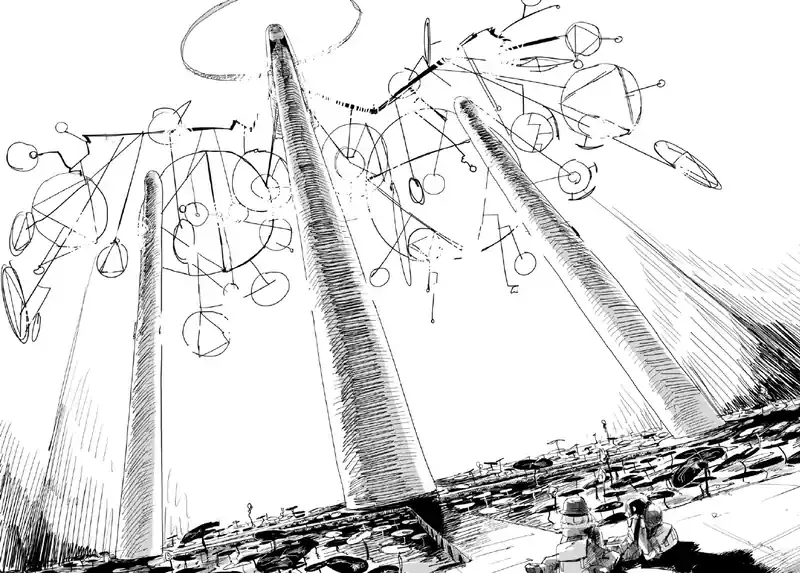
What lingered with me most was the scale of the world itself. Humanity built structures so massive that they seem almost impossible to reconcile with the emptiness that follows. The cities, the machinery, the endless levels, the long stairways, the towers, the enormous stretches of concrete and metal all feel like evidence of a civilization that was capable of reaching far beyond its own limits, yet still could not save itself. That contrast is one of the strongest parts of the series. The world is full of signs of intelligence and ambition, but there is no one left to inhabit it.
The series touches on the philosophical difference between permanence and presence. Human civilization in the story is full of things that were clearly built to last, yet almost none of them have any lasting purpose anymore. That creates a painful contradiction. Everything concrete, metal, and monumental begins to feel fragile simply because the people who gave it meaning are gone. The series seems to suggest that permanence is an illusion unless there is someone there to witness it. Without consciousness, even the most impressive structure becomes only debris. In that sense, the girls are not just travelers. They are witnesses, and their awareness is what keeps the world from becoming completely mute.
The temple in the city left a strong impression on me for the same reason. Even though it was untouched by destruction, it was also revealed to be artificial in a way that made it feel more unsettling than sacred. The lake, the fish, the flowers, and the leaves were all manufactured rather than real. That scene says a lot about the series without needing to explain itself too much. It suggests a world where even beauty may have been built as a replacement for something lost.
Philosophically, what makes Girls’ Last Tour so striking is that it refuses to give meaning in the usual way. There is no larger purpose waiting at the end of the journey, no restoration of the world, and no final explanation that makes everything feel justified. Instead, the series suggests that meaning is something small, temporary, and made by the people who are still alive to experience it. A meal, a conversation, a shared shelter, or a moment of curiosity becomes significant not because it solves anything, but because it exists at all. That is part of why the story feels so thoughtful. It does not argue that life is meaningful in a grand cosmic sense. It shows that meaning can still be constructed inside emptiness.
The relationship between Chito and Yuuri is the core of the series for me. They are not written as some idealized pair who perfectly understand each other, but as two people who have simply learned how to continue existing together. Their bond matters because the world around them is so empty. Their conversations, their habits, their small disagreements, and the way they rely on each other all give the story its warmth.
Without them, the series would just be ruins.
With them, the ruins start to feel inhabited again, even if only briefly.
Psychologically, that same emptiness makes the girls’ behavior feel very human. They are living under conditions that would normally produce despair, yet they continue functioning by narrowing their attention to what is immediate and tangible. They focus on food, movement, routines, and each other because those things are still controllable. In that sense, the series feels like a study of adaptation. When the world becomes too large, too ruined, or too uncertain to process all at once, the mind often survives by reducing life to the smallest manageable units. Chito and Yuuri do not reject their reality; they cope by living inside it one moment at a time.
Another thing that stayed with me was how few humans actually appear in the manga. For a six-volume series, the number is surprisingly only two besides the girls. That made every human encounter feel important, especially because it reinforced how far gone the world already was. Yuuri and Chito’s grandfather also felt significant in that regard, because he connects them to a human past that has already slipped away. The series never treats that past as glorious or safe. It simply makes it feel distant.
The idea of God, Nuko, and Eringi is another part that stayed in my mind. The series never fully explains what they are, which is part of what makes them work. They could be something from space, something artificial, or even a kind of biological weapon. I personally lean toward the bio-weapon interpretation, because it fits the strange, post-human logic of the world better. In a setting where human creation has outlived human civilization, it makes sense that even the most mysterious lifeforms would be tied to that same collapse.
What also hit me was how the girls think about the world, life, and death. Their perspective is very plain, but that is what makes it effective. They are not philosophers in the formal sense, yet the things they say often feel more honest than a long speech about meaning would. They are too small to understand the full shape of the world, but they are still trying to make sense of it. That gives the story a very human quality even after humanity itself has vanished.
There is also something deeply psychological about the way the series handles loneliness. It does not portray loneliness as only sadness. Sometimes it is quiet, routine, and even normal. The girls have learned how to live with absence so completely that absence becomes part of the atmosphere rather than a crisis. That is unsettling, but it is also realistic. People do not always collapse in the face of isolation; sometimes they adapt to it so thoroughly that they stop noticing how much has been lost. Girls’ Last Tour captures that feeling with unusual precision, which is why it lingers. It understands that the mind can survive almost anything, but that survival does not mean recovery.
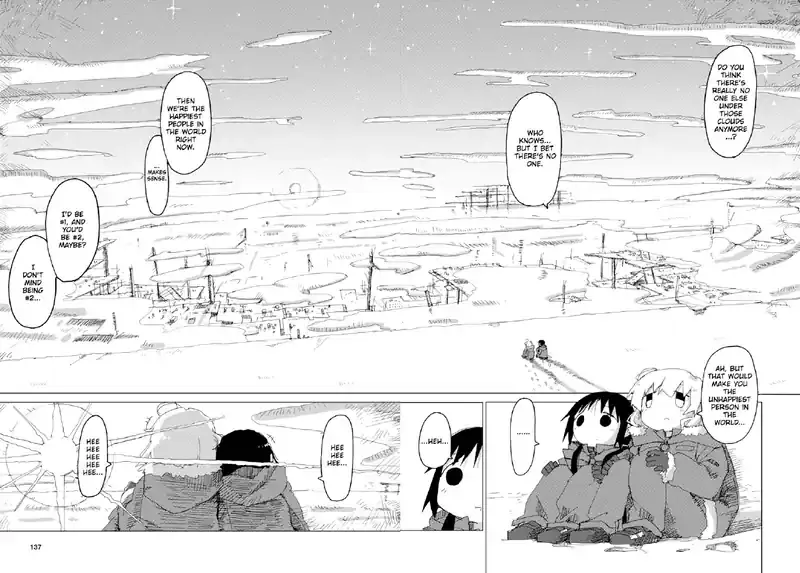
The anime ending gave me chills when I realized that Chito and Yuuri were now the last remaining humans. That moment changes the emotional weight of everything that came before it. It is not just that the world is empty. It is that the last witnesses to that world are these two girls, drifting through it with no real certainty about what comes next. The scene of the photo folders also stood out to me for the same reason. It felt like a record of humanity passed down from generation to generation, and one of the most heartwarming moments in the entire series.
The other moment that still stands out is the one where the missile and laser are launched from the robot. The sheer scale of that power is absurd. It makes you wonder why humanity ever needed weapons like that in the first place, or what kind of world would produce them. The fact that so much destructive force exists in a setting that is already dead only adds to the sense that humanity outpaced itself long before the end arrived.
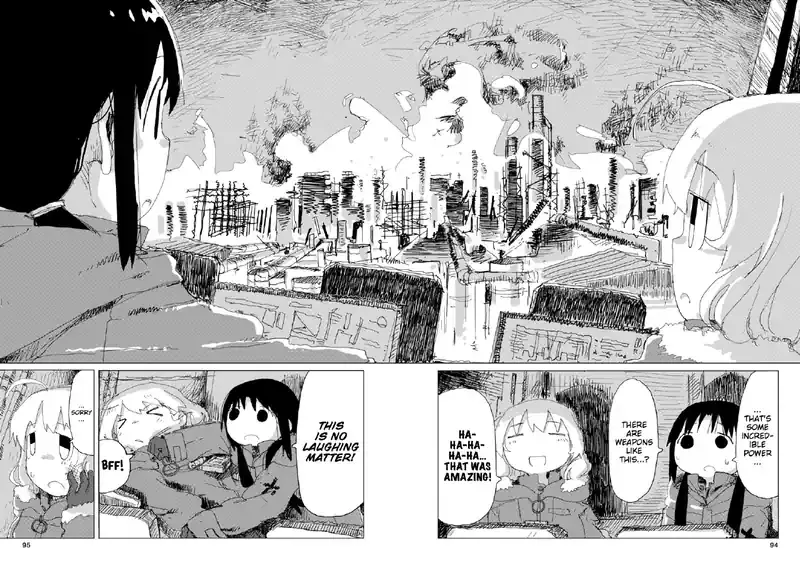
What makes that scene even more disturbing is that the weapons no longer seem connected to any human purpose. The civilizations that created them are gone, yet the machinery still exists, dormant and functional long after the people behind it disappeared. In that sense, the series presents technology as something that escaped human scale. Humanity kept building systems of greater complexity and destructive capability, but eventually reached a point where those creations felt more permanent than human life itself.
The missile and laser do not feel triumphant or powerful. They feel indifferent, as though the world continued producing force long after it forgot why that force was ever needed.
After finishing the anime, I continued with the manga from Chapter 33, and that is where the series changed for me. Up until that point, I already appreciated its atmosphere and ideas, but they had not fully settled into me yet. The final episodes of the anime deepened the emotional weight considerably, especially once the reality of the girls’ isolation fully became clear. But it still did not become something unforgettable to me until I read the manga continuation.
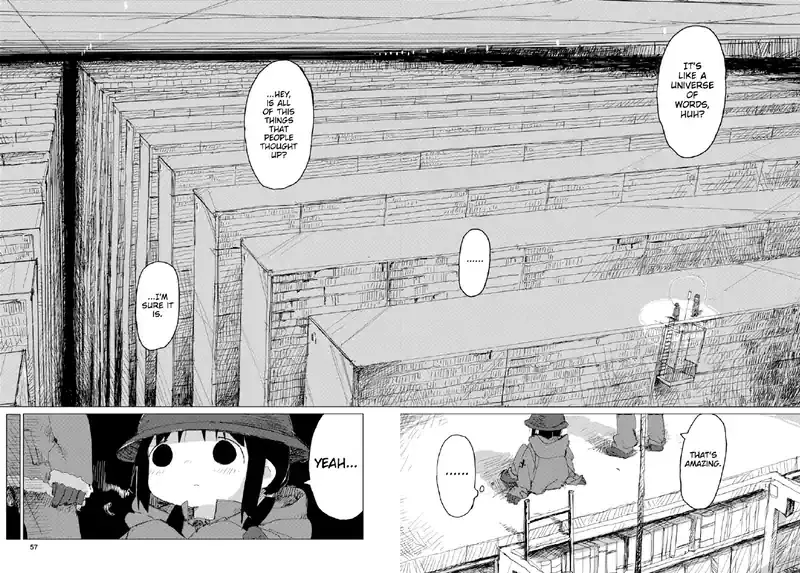
The mood shifts completely once the girls reach the top level by elevator and begin throwing things away. The Kettenkrad breaks down. The books are slowly burned. The food runs out. The journey becomes more stripped down and more exhausting, but also more honest in a strange way. The library especially stayed with me. Its scale was so vast that it felt comparable to an entire city, which made it even sadder that all of that knowledge could exist with no one left to truly use it.
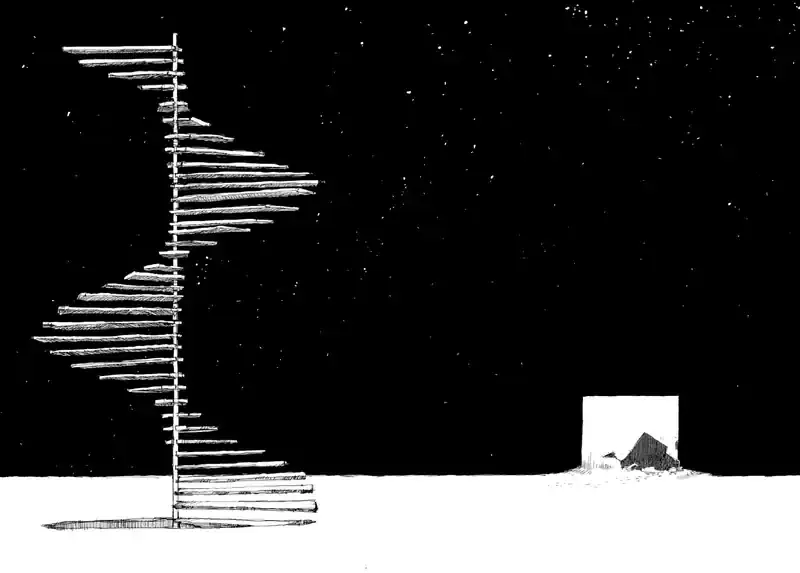
The infinite staircase to the top was one of the strongest images in the entire manga. Chito and Yuuri holding each other’s hands and walking upward day after day in complete darkness, eventually reaching the point where they even stop speaking, is a very powerful way to end that stretch of the story. It captures exhaustion, trust, and devotion without needing to force anything. The atmosphere in the final level changes so much that it almost feels like the series is shedding its own shape.
What I ended up remembering most were the girls reaching the top, the temple, the giant tower to the last level, the Kettenkrad, humanity’s last flight, Nuko and Eringi, the folders in the nuclear submarine, the infinite staircase, the library, and the way the atmosphere changes completely in the last level. Those are the parts that stayed with me because they all point to the same thing: a civilization that built too much, understood too little, and vanished anyway, leaving behind two girls who keep moving forward because there is nothing else left to do.
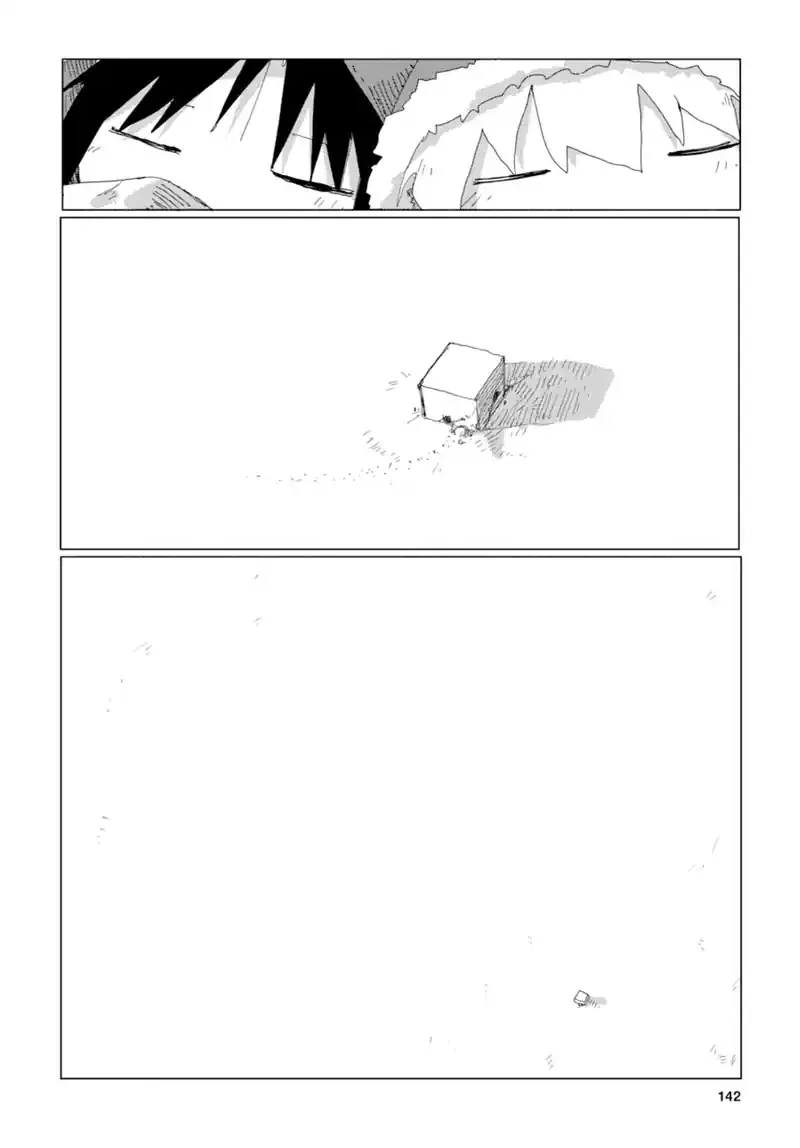

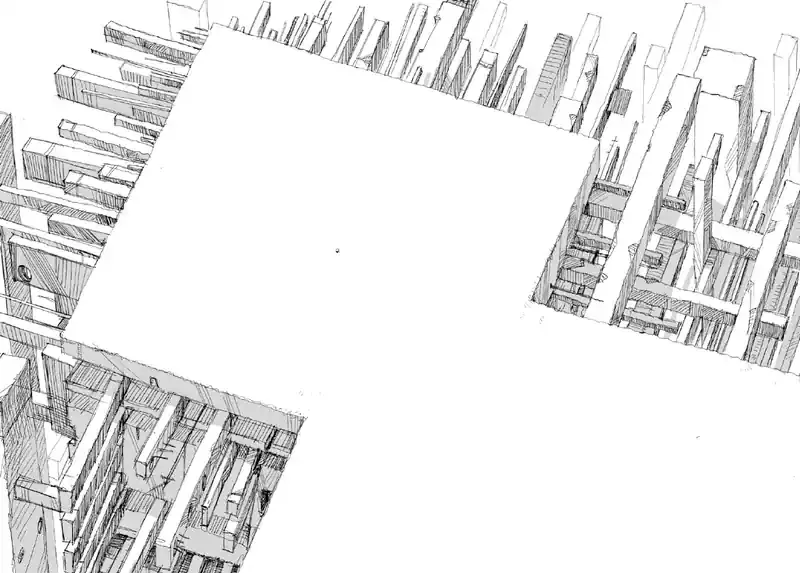
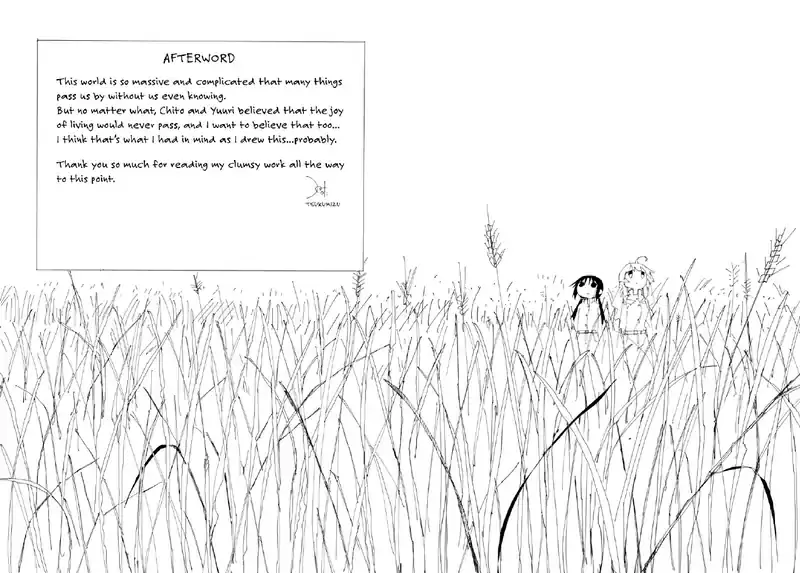
Girls’ Last Tour feels less like a conventional story and more like a meditation on what remains after the end. It is about scale, loss, companionship, memory, and the strange persistence of life in a world that no longer has any clear reason to continue. The ending of the anime gave me melancholy. The ending of the manga gave me something colder, but also more lasting. Both stayed with me.